Project map overview
Learn about our planned and ongoing projects around Hamilton City and Waikato District.
Our major projects
Over the next decade we are investing around $3 billion to make sure we keep delivering high quality, sustainable water services, support planned growth and protect our environment.
We’re working right across the IAWAI region to support our communities, and to make sure our plans support and align with the future needs of our neighbours.
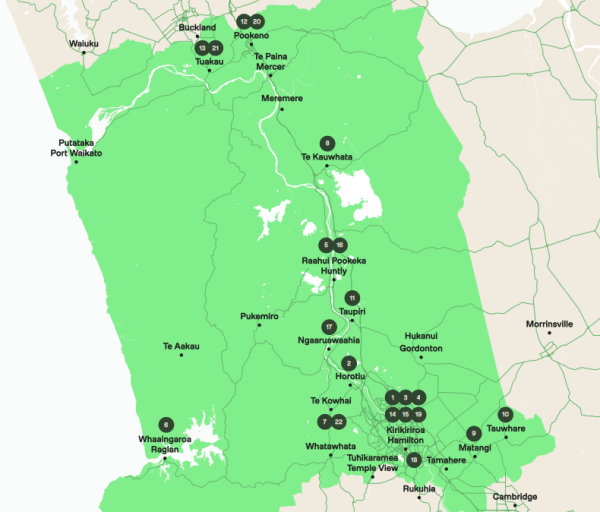
- Upgrade Waiora Water treatment plant
- Hamilton and Ngaaruawaahia subregional water treatment plant
- 25M-litre Hamilton central city reservoir
- Hillcrest reservoir, pump station and large water pipes
- Huntly water works
- Raglan water works
- Te Koowhai water works
- Te Kauwhata water works
- Matangi water works
- Eureka water works
- Taupiri water works
- Pookeno water works
- Tuakau water works
- Fairer charging, Hamilton water metering rollout and Waikato District meter upgrade (digital meters)
- Pukete Wastewater Treatment Plant upgrade
- Huntly Wastewater Treatment Plant upgrade
- Ngaaruawaahia Wastewater Treatment Plant upgrade
- Southern Wastewater Treatment Plant
- Hamilton bulk wastewater storage tanks
- Pookeno wastewater service capacity
- Tuakau wastewater service capacity
- Te Koowhai water, wastewater and stormwater infrastructure
We’re investing in our communities
Over the next decade, IAWAI will invest more than $3 billion in water and wastewater infrastructure all across Waikato District and Hamilton - of which $2 billion is in response to growth.
That requires a much more strategic and disciplined approach. There can be no ‘fat’ in the system – our programme is focused on doing the most important things first.
Operating as a single entity allows us to plan and invest across the region, rather than being constrained by council boundaries. We have greater flexibility around debt and can take a more commercial, long-term view of investment.
Here’s some of our key projects and their estimated costs:
Drinking water and reservoirs
1: Upgrade the Waiora Water Treatment Plant to increase water storage and introduce a new waste stream solution. Estimated cost (2026-2036) $88.6 million.
2: New subregional water treatment plant to service Hamilton and Ngaaruawaahia initially - $97.5m
3: Build a 25 million litre reservoir for central Hamilton by 2028. This will improve water supply resilience including firefighting capacity, support long-term city growth, and enable around 4000 new homes in the city centre. Estimated cost (2026-2036) $150.6million*
*This work is funded by the Infrastructure Acceleration Fund – a government fund set up to pay for essential infrastructure that unlocks new housing and supports growth. Hamilton City Council secured this funding in 2022.
4: A new reservoir, pump station and large water pipes to improve water supply reliability in Hillcrest. The project will reduce water loss, improve efficiency, strengthen resilience to demand changes, and create capacity to support future growth. Estimated cost (2026-2036) $57.2 million.
New or upgraded water infrastructure, including treatment plants, pipes, extensions, pump stations
5: Huntly water works $30.8 million
6: Raglan water works $22.2 million
7: Te Kowhai water works1 $15.15 million
8: Te Kauwhata water works1 $63.7 million
9: Matangi water works $13.3 million
10: Eureka water works $5 million
11: Taupiri water works1 $7 million
12: Pookeno water works $18.8 million (co-funded by other parties)
13: Tuakau water works $16.15 million (co-funded by other parties)
Fairer charging
14: The rollout of residential water meters in Hamilton. This would support the transition from capital value-based charging to volumetric charging, as required by legislation and to move to a fairer user-pays charging method. There are already 4000 commercial and industrial water meters in Hamilton. Waikato District Council has had water meters since 2016; this funding includes upgrading their stock to digital meters. Estimated cost (2026-2036) $108.7 million.
Wastewater treatment plants
15: Major upgrades to Pukete Wastewater Treatment Plant, Hamilton’s only wastewater treatment plant, to increase capacity, performance and resilience. This investment will support future population growth, improve environmental outcomes, and service Ngaaruawaahia. Estimated cost (2026-2036) $404million.
16: Upgrade the Huntly Wastewater Treatment Plant to bring it into compliance and support future growth. Estimated cost (2026-2036) $41.6million.
17: Upgrades to the Ngaaruawaahia Wastewater Treatment Plant are needed to make it compliant, support growth in the surrounding area and allow for the future transfer of wastewater to an upgraded Pukete plant. The upgrades are being designed so key components can be reused or relocated to support growth and compliance elsewhere once wastewater is redirected to the Pukete Wastewater Treatment Plant. Estimated cost (2026- 2036) $35 million.
New infrastructure
18: Planning and implementation of a new, Southern Wastewater Treatment Plant. Built to modern standards, and in stages to support growing communities, it will treat wastewater to a high standard, reduce pressure on Pukete, and enable new housing and business growth while protecting the Waikato River. Estimated cost (2026-2036) $134.9million.
19: Installation of bulk wastewater storage tanks in Hamilton. This will allow us to manage extra wastewater during heavy rain when the system can become overloaded. A total of seven storage tanks are planned. Four of these will be built between 2026-2036. Estimated cost (2026-2036) $139.4 million.
Planning for growth
20 and 21: Increasing wastewater servicing capacity for Pookeno and Tuakau. We’re exploring a private partnership to deliver a new wastewater treatment plant.
22: Progressing a solution for water, wastewater and stormwater infrastructure in Te Kowhai to support growth.
Water and wastewater renewals
We will keep reinvesting in our existing water infrastructure. We will increase the pace and scale of renewals, prioritising the highest-risk assets and extending the life of what we already have. This will be delivered through long-term partnerships with contractors, giving greater certainty, stronger forward planning, and better value over time.